
Facial Roller: Up or Down? The Direction Guide Your Face Actually Wants
You picked up your facial roller for the first time, pressed it against your cheek, and froze. Up? Down? Outward? You checked two TikToks and got two different answers. One creator insisted "always up — gravity is your enemy." The next one rolled straight down her neck and called it "the only way that works." So which one is right?
Both are. That's the frustrating, honest answer to the question facial roller up or down — and the reason most beginners give up after a week. The direction isn't arbitrary. It depends on what you're trying to do, which zone of the face you're on, and how your lymphatic system is actually plumbed. Once you understand those three things, the confusion evaporates.
Key takeaway:
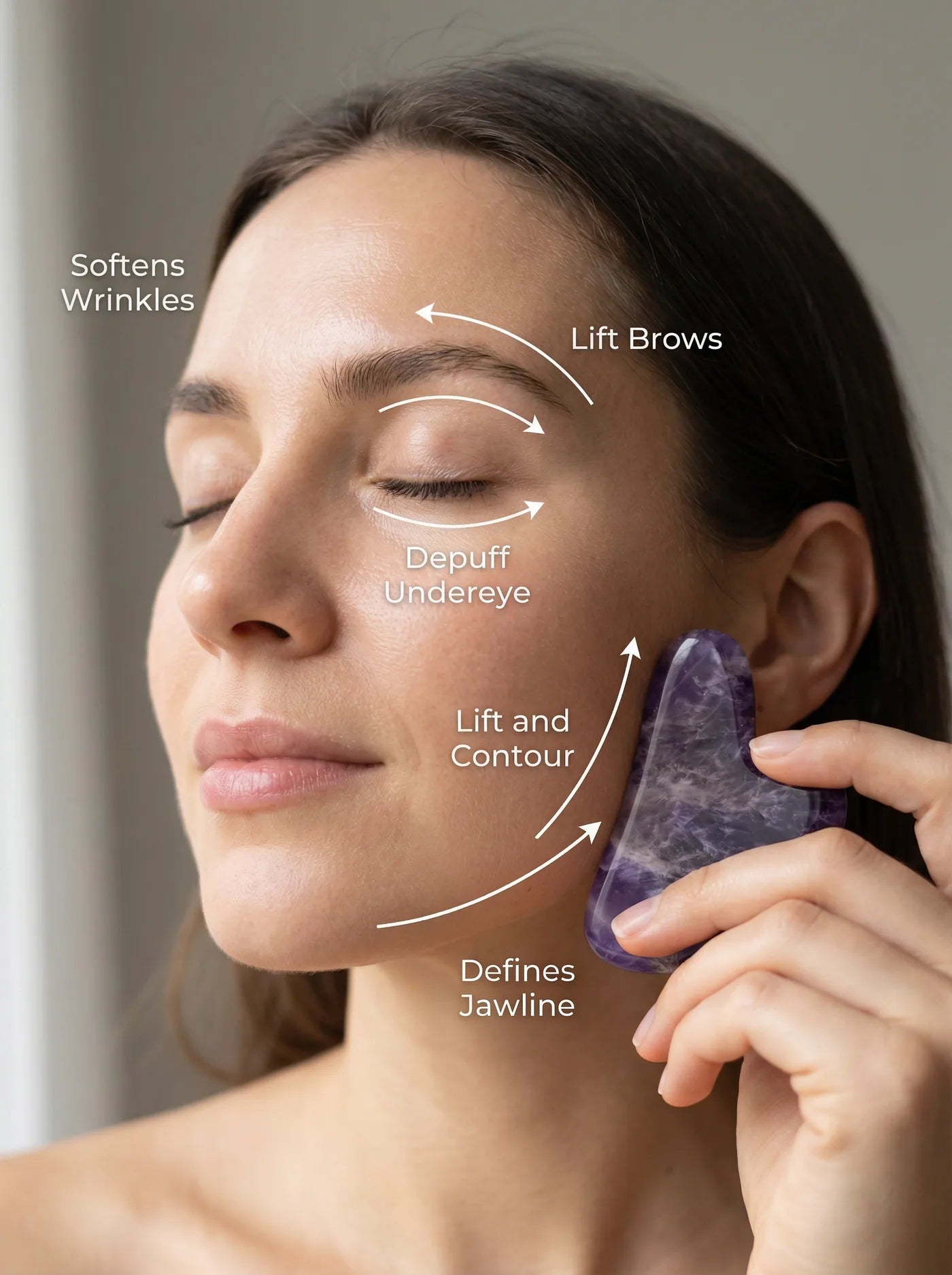
Roll up and outward on the face (center to ears), then down on the neck (jawline to collarbone). The face uses upward strokes to encourage lift and push fluid toward lymph nodes near the ears; the neck uses downward strokes to drain that fluid out via the collarbone. Do both in sequence, always finishing with the neck. That single 90-second rule fixes 80% of technique mistakes.
The Short Answer (and Why It's Not Enough)
If you only have ten seconds, here it is: roll up and out on your face, then straight down on your neck. Never reverse that order. Never pull skin down on the face. Always finish at the collarbone.
That's the TikTok-length answer and it's technically correct. But it hides the nuance that determines whether you'll see results in two weeks or never. Your face has five distinct drainage zones. The jawline drains toward the ears. The forehead drains toward the temples. The under-eye drains toward the outer corner, not straight up into your brow. Apply "up" universally and you'll push fluid into places it doesn't want to go — which is why some people end up more puffy after rolling, not less.
So the real answer is: there is a direction for every zone, and the directions don't all point the same way. Let's map them.
Why this question keeps coming up
Facial rollers look symmetrical. A jade or amethyst roller rolls smoothly in both directions. Nothing about the tool itself tells you which way is correct. And unlike a razor or a toothbrush, no one's mom ever demonstrated facial roller direction at the bathroom mirror. You're learning from 15-second videos made by people who themselves learned from 15-second videos. The signal-to-noise ratio is terrible.
The upside: once you understand the why, you never have to memorize again. You just feel it.
How Facial Lymphatic Drainage Actually Works
Every direction recommendation in this article is downstream of one biological fact: your face has a one-way plumbing system called the lymphatic system, and it flows toward specific exit points. A 2016 review in the Journal of Anatomy by Földi and colleagues mapped the superficial lymphatic drainage of the head and neck in detail. The headline finding: facial lymph drains toward clusters of nodes behind and below the ears (parotid and cervical lymph nodes), then downward through the neck into the thoracic duct near the collarbone.
Your face doesn't drain straight up into your scalp. It drains outward toward your ears and downward through your neck. That's why "up and out" works: you're following the natural angle of the lymphatic vessels, pushing fluid toward the exits.
Clinical Rehabilitation (2015) found that manual lymphatic drainage reduces facial edema by approximately 30% when performed with light, directional strokes toward lymph nodes. Notice the word "directional." Random rolling in both directions doesn't produce the same effect — you're essentially sloshing fluid back and forth. Directional rolling moves it out.
The three exit points you need to know
Memorize these and everything else falls into place:
- Pre-auricular nodes (just in front of the ears) — destination for forehead, cheek, and temple drainage
- Post-auricular and cervical nodes (behind the ears, down the side of the neck) — destination for jawline and lower face drainage
- Supraclavicular nodes (above the collarbone) — final exit for everything, reached by rolling down the neck
Every stroke should end at one of those three points. If your stroke doesn't end at a lymph node, it's not draining anything.
"Up for Lift, Down for Drainage" — The Myth With a Kernel of Truth
You've probably seen this rule: "Roll up if you want to lift, roll down if you want to drain." It's half-true and half-dangerous. Here's the truth buried inside it.
Rolling up and out on the face creates a mechanical lifting sensation because you're moving tissue against gravity. Combined with the lymphatic effect, this is what produces the "just woke up and my cheekbones are sharper" look. The kernel of truth: upward strokes on the face do have a temporary lifting effect.
Rolling down on the neck is correct for drainage because that's the actual direction lymph needs to travel to exit. The kernel of truth: downward strokes on the neck are non-negotiable for drainage.
Where the myth goes wrong: people hear "down for drainage" and roll down on their face. That pushes fluid away from the lymph nodes, not toward them. It can increase puffiness temporarily because you're pooling fluid in areas that don't have drainage exits (like the mid-cheek or under-eye). Never roll down on the face. Ever.
The corrected version of the rule
Replace the folk rule with this: Up on the face. Down on the neck. Always in that order. That single substitution gets you 95% of the benefit and prevents the most common beginner mistake.
Zone-by-Zone Direction Map (The Only Chart You Need)
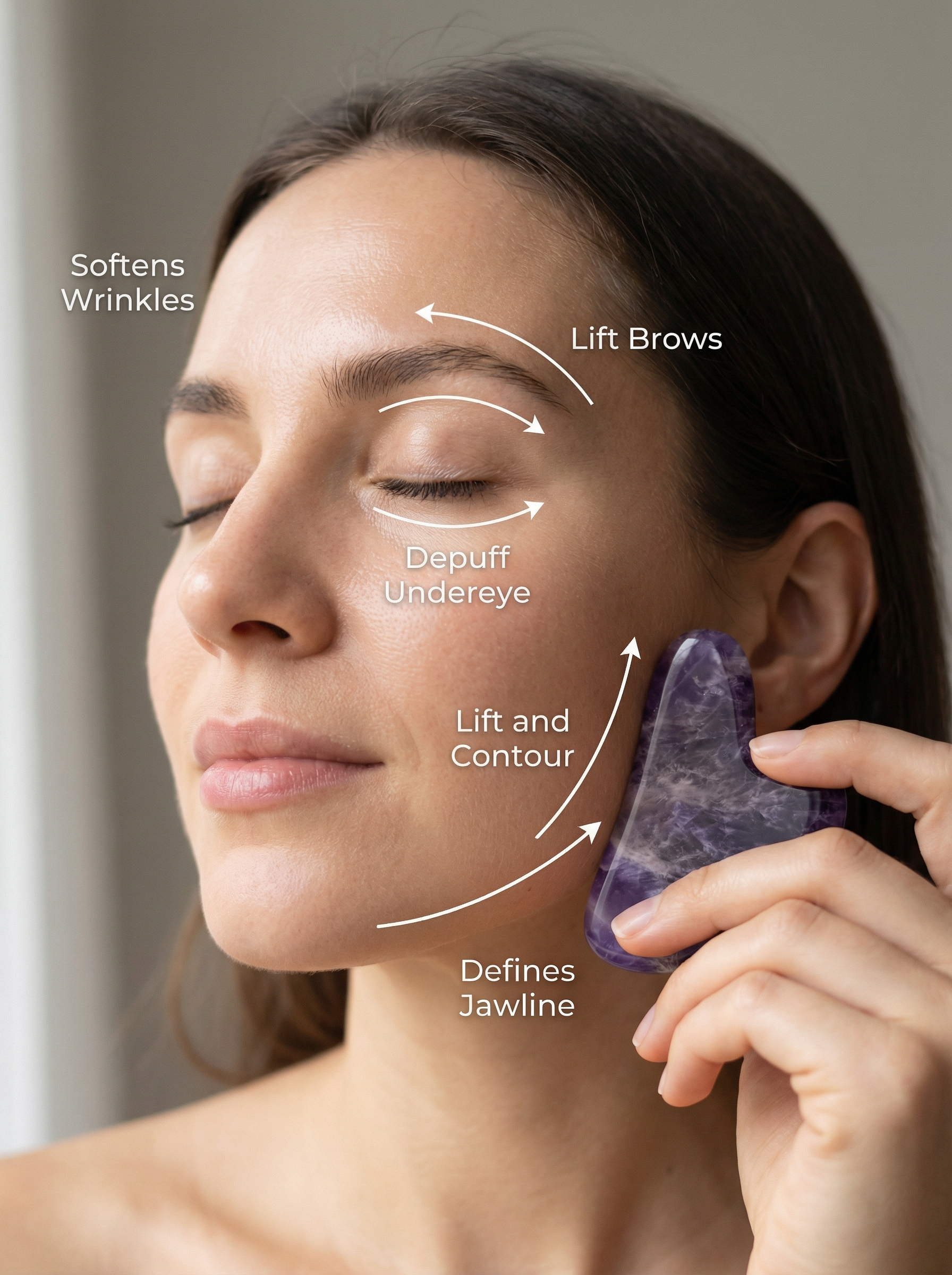
Here's the complete direction guide, broken down by facial zone. Print it, screenshot it, tape it to your mirror. Follow it once and it becomes muscle memory by day three.
Forehead
Direction: Center of forehead outward to the temples, with a slight downward angle at the end. Some guides say "up from brows to hairline" — that's fine for softening horizontal lines, but it doesn't drain. The outward stroke toward the temples does both: it smooths the forehead and delivers fluid to the pre-auricular nodes.
Strokes: 5 per side, center to temple. Then 5 vertical strokes from brow up to hairline for the "lift" effect.
Under-eye
Direction: Inner corner to outer corner, finishing at the temple — never in reverse. The orbital area is the most common zone where people get direction wrong. Rolling from outer corner inward pushes fluid toward the tear duct and can make morning puffiness worse.
Strokes: 5 per side. Gentle pressure only. The skin under the eye is 40% thinner than the rest of the face — this isn't the zone to press hard.
Cheeks
Direction: Outward and slightly upward, from the side of the nose and middle of the cheek out toward the top of the ear. This is the "up and out" zone people are thinking of when they give the shorthand answer. Cheek fluid drains to the pre-auricular nodes just in front of the ear.
Strokes: 5–8 per side. This is where most of your visible sculpting happens, so don't rush.
Jawline
Direction: From chin outward along the jawbone, ending just below and behind the earlobe. Follow the jawbone's natural curve — don't cut diagonally across the cheek. This stroke hits the masseter (the chewing muscle) and drains toward the post-auricular nodes. If you want more detail on this specific zone, we broke it down in how to use gua sha for jawline.
Strokes: 5–8 per side. If you hold tension in your jaw (TMJ, teeth grinding), increase to 10.
Neck — the direction reversal
Direction: Straight down, from just behind the ear and from the jawline all the way to the collarbone. This is the only zone where down is correct. You're escorting all the fluid you just pushed to the lymph nodes down and out through the supraclavicular exit.
Strokes: 8–10 per side. Light pressure. The neck has major blood vessels close to the surface — there's no benefit to pressing hard here.
If you skip this step, everything you did above was half the work. The neck is where drainage finishes. Always finish at the neck. For a fuller breakdown, see our guide to facial lymphatic drainage.
Chest and collarbone (bonus — most people skip this)
Direction: Light horizontal sweeps along the top of the collarbone, outward toward the shoulder.
Strokes: 3 per side. This opens the supraclavicular node — the final exit. Think of it as opening the drain before pouring water in.
Neck drainage stroke sequence — always finish here, straight down to the collarbone.
When Rolling Down Is Actually Correct
The universal rule is "up on face, down on neck." But there are three specific situations where down on the face is not just acceptable — it's better.
1. Heavy morning puffiness
If you woke up with significant under-eye puffiness (late dinner, salty food, alcohol, crying, hormonal cycle), your priority is drainage, not lift. Start with a cold tool — an ice roller ($19) works beautifully — and make your first pass downward from the outer cheekbone toward the jawline. This pulls pooled fluid down toward the lymph nodes faster than the outward-and-up sequence.
After that first drainage pass (60 seconds), switch to the standard up-and-out direction for the rest of the routine.
2. Post-procedure or post-injection
If you've recently had filler, Botox, or a skin procedure (and have been cleared by your provider to resume massage), always follow their specific direction protocol. Many providers recommend gentle downward drainage strokes only for the first 1–2 weeks to avoid displacing product. This is a medical situation, not a beauty one. Follow your provider, not TikTok.
3. Neck and chest — always down
We covered this in the zone map, but it bears repeating: from the jawline down, the direction is always down. If you're unsure whether a stroke is "face" or "neck," draw an imaginary line at your jawbone. Above = up. Below = down. That's the rule.
The 5-Minute Morning Sequence (Up + Down Combined)
Here's the exact order we follow at BY RITUEL, every morning, on camera and off. Five minutes, both directions used correctly.
Step 1 — Prep (30 seconds)
Apply a pea-sized amount of rosehip oil ($15) or your serum to clean, dry skin. Rolling on dry skin causes friction and tiny stretches that make fine lines worse over time. Oil makes the roller glide.
Step 2 — Open the drain (20 seconds)
Start at the collarbone with 3 light outward sweeps per side. Then press the area just behind the ears (lymph nodes) gently with two fingers, 10 seconds. You're opening the exit before moving fluid toward it.
Step 3 — Neck, down (40 seconds)
Roll down the sides of the neck, from jawline to collarbone, 8 strokes per side. Counterintuitive to start here, but this is the drainage warm-up.
Step 4 — Jawline, out (40 seconds)
Chin to earlobe, following the jawbone, 6 strokes per side. Pause below the earlobe for a 3-second hold on each side to finish the drainage.
Step 5 — Cheeks, up and out (50 seconds)
Side of nose and mid-cheek outward toward the top of the ear, 6 strokes per side. This is the zone where "up and out" is most visible.
Step 6 — Under-eye, in to out (30 seconds)
Inner corner to outer corner to temple, 5 strokes per side, light pressure only.
Step 7 — Forehead, center to temples (40 seconds)
Center outward to the temple on both sides, 5 strokes. Then 5 vertical strokes brow to hairline.
Step 8 — Finish down the neck (30 seconds)
Repeat Step 3. You just drove a lot of fluid to the nodes — close the loop by sending it out through the neck.
Total: about 5 minutes. You used up on five zones and down on two (and one sideways). The whole sequence is in our 5-minute morning gua sha routine guide if you want to save or print it.
Full morning sequence at the vanity mirror — up on the face, down on the neck.
Direction Mistakes That Cancel Your Results
If your results have been underwhelming after 2–3 weeks of daily rolling, one of these is probably why.
Mistake 1: Rolling back and forth
The roller rolls in both directions, so it's tempting to scrub back and forth like you're polishing a window. Don't. Back-and-forth doesn't drain — it sloshes fluid in place. Every stroke must be one-directional: press down, glide in the correct direction, lift off, reset, repeat.
Mistake 2: Rolling down on the face
The single biggest error. Some creators show dragging the roller from temple to jaw "to slim the face." This pushes fluid away from the lymph nodes near the ears and pools it in the lower cheek. Always roll away from the center and toward the ears on the face.
Mistake 3: Skipping the neck
You spent 4 minutes pushing fluid to lymph nodes, then skipped the 30 seconds that actually drain them. This is like running a bath with the drain closed — fluid has nowhere to go. The neck is 40% of the results.
Mistake 4: Reversing under-eye direction
Rolling outer-to-inner on the under-eye pushes fluid toward the tear duct. Morning puffy eyes get worse, not better. Always inner corner to outer corner.
Mistake 5: Wrong pressure for the direction
Upward strokes on the face benefit from moderate pressure (40–60%). Downward strokes on the neck should be light (20–30%) because you're draining along, not sculpting. Using jawline pressure on your neck is how people cause broken capillaries on the neck's delicate skin. See our pressure guide for zone-specific numbers.
Mistake 6: Forgetting to oil
Correct direction with no oil equals friction burn. The tiny repeated tugs on dry skin, even in the right direction, pull skin in ways that can create fine lines over time. A drop of oil is not optional.
A visual demo of the zone-by-zone direction flow — useful on your first day.
What Direction Can't Fix (Be Honest With Yourself)
Correct direction improves results by a meaningful amount. But it won't do these things, no matter how perfect your technique:
- It won't reduce fat. A facial roller does not break down subcutaneous fat cells. If your "puffiness" is actually buccal or cheek fat, no direction change affects it. See our honest piece on whether gua sha slims your face.
- It won't lift sagging skin permanently. The "lift" from upward rolling is temporary tissue displacement and reduced fluid. It lasts hours, not weeks. Daily use keeps the effect compounding, but stop for a month and you'll return to baseline.
- It won't fix genetic under-eye bags. If your bags are herniated fat pads (often genetic, often visible from age 25), direction changes nothing. That's surgical, not tool-based.
- It won't replace sleep, water, or low sodium. Chronic puffiness from lifestyle factors needs lifestyle fixes. A roller at 7am can't undo wine, salt, and 4 hours of sleep from the night before — it can only help your system process what's there.
- It won't work on dry skin. The correct direction with no slip creates pull, which over time is worse than doing nothing. Oil is mandatory.
Direction is one ingredient in a working routine. It's necessary, not sufficient.
Does Direction Change for Gua Sha vs Roller?
Short answer: no, the directions are the same. The tools differ in how they apply pressure, not where they move fluid. Your lymphatic system doesn't know or care which tool is on top of it.
That said, the two tools have different strengths:
| Aspect | Facial Roller | Gua Sha |
|---|---|---|
| Best for | Drainage, de-puffing, beginners | Sculpting, muscle release, jawline definition |
| Pressure control | Self-limiting (harder to over-press) | Full range (beginner risk of over-pressing) |
| Learning curve | Very low — forgiving | Medium — takes 2 weeks to master angles |
| Directions | Same as gua sha (up + out on face, down on neck) | Same as roller |
| Price at BY RITUEL | Amethyst Facial Roller $16 | Amethyst Gua Sha $22 |
If you're brand new and direction feels confusing, start with an Amethyst Facial Roller ($16) — the rolling motion almost enforces correct direction because you naturally push and release rather than drag. Once direction is muscle memory, add a gua sha for the sculpting work. Many of our customers end up using both: roller for morning drainage, gua sha for evening sculpting. Our full amethyst gua sha guide covers the progression.
The Science Behind Direction (If You Want the Receipts)
Lymphatic flow follows anatomy, not gravity
Földi's Textbook of Lymphology (referenced widely in the 2016 Journal of Anatomy review) documents that the face has a dense network of superficial lymphatic capillaries draining to roughly 300 cervical lymph nodes. The pathways are fixed. They go outward to the ears, then down through the neck. This isn't folklore — it's vascular anatomy.
Nielsen 2007: why directional strokes increase circulation
A 2007 study by Nielsen et al. in Explore: The Journal of Science and Healing measured microcirculation during gua sha strokes. They found a ~400% increase in surface microcirculation at stroked sites. Direction mattered because the stroke compresses the vessel in one direction, pushing blood along — not pulling it back. Random or bidirectional scraping produced less measurable effect.
Clinical Rehabilitation 2015: directional drainage works
This study found manual lymphatic drainage reduces facial edema by around 30% — but only when performed with one-directional strokes toward lymph nodes. The paper explicitly noted that untrained bidirectional massage did not produce the same result. Direction is the variable.
If you want a deeper dive into the research, we rounded up the numbers in gua sha statistics and research.
What to Expect When You Fix Your Direction
Day 1
Immediately after: a subtle glow and slightly reduced under-eye puffiness. This is circulation and short-term fluid shift. Lasts 3–5 hours.
Week 1
Morning puffiness reduces faster. You "wake up looking awake" within 10 minutes of rolling instead of 45 minutes. Jawline feels less tense.
Week 2–3
Visible cheekbone definition returns. Under-eye appears less shadowed because chronic fluid retention has resolved. Skin glow is more consistent throughout the day.
Week 4+
Plateau — your face has found its drained baseline. Maintenance mode. If you stop for 10+ days, puffiness returns within 3–5 days. This isn't a permanent change; it's a daily practice that accumulates benefits while you do it.
Additional direction demo — note how every stroke finishes at the neck.
Frequently Asked Questions
Is a facial roller used up or down?
Up and outward on the face (center to ears), down on the neck (jawline to collarbone). Never roll straight down on the face itself — that pushes fluid away from the lymph nodes near the ears and can worsen puffiness.
Why do some people say to roll down?
They're usually talking about the neck (where down is correct) or confusing "drainage" with "downward direction." Facial drainage is outward from center, not downward. Only the neck is rolled straight down.
Should I roll under my eyes toward my nose or toward my temple?
Toward your temple. Inner corner to outer corner, finishing past the outer eye. Rolling toward the nose pushes fluid to the tear duct area and can make puffy eyes look worse.
Does it matter which direction for reducing wrinkles?
Yes. Consistently pulling skin in one direction (up and out) is gentler than back-and-forth motion, which can contribute to fine lines over time. Correct direction paired with facial oil minimizes friction and supports skin quality.
How many strokes per zone per direction?
5–8 strokes per zone, in the correct direction only. More is not better — after about 10 strokes, you're no longer adding drainage, just irritation.
Can I roll down on my face if I'm really puffy in the morning?
You can do a first "drainage pass" downward from cheekbone to jawline for 60 seconds when puffiness is severe. But switch back to up-and-out direction after that initial pass — sustained downward rolling on the face is not the routine.
Should I roll with a cold or room-temperature tool?
Cold is better for morning drainage — cold constricts vessels and reduces inflammation faster. A chilled stone or a Rose Ice Roller ($19) accelerates the de-puff effect. Room temp is fine for evening sculpting work.