
Published April 19, 2026 · 11 min read · BY RITUEL Editorial
Facial Roller for Sinus Pressure: The Cold-Therapy Method That Actually Helps
It's 7 a.m. Your forehead feels like it's being squeezed in a vice. Your cheeks ache when you bend over to tie your shoes. You've taken the antihistamine, drunk the water, done the steam shower — and you still feel like someone inflated a balloon behind your face. You've heard people online talk about using a facial roller for sinus pressure, and you're wondering: is this actually a thing, or is it another TikTok placebo?
Here's the honest answer: a cold facial roller can provide real, temporary relief from the pressure sensation caused by inflamed sinus tissues. It won't cure a sinus infection, won't drain your sinuses like a neti pot, and won't replace decongestants when you need them. But for the mild-to-moderate daily congestion most of us deal with during allergy season, a cold (not frozen) roller used on three specific pressure points can take the edge off in about 90 seconds. This guide shows you exactly how — and when to skip it and call a doctor instead.
Key takeaway:
Use a chilled (fridge, not freezer) stainless-steel or stone roller on three sinus points — brow bone, under-eye cheek, and sides of the nose — for 60 to 90 seconds each, gliding outward toward the ears. This constricts blood vessels in the inflamed mucosa and provides 20 to 40 minutes of pressure relief. It is symptom relief only. If symptoms last more than 10 days or you have fever, facial swelling, or visual changes, see a doctor.
Why cold pressure can relieve sinus congestion (the mechanism)
Before you roll, it helps to understand why this works at all. The "pressure" you feel isn't air pressure — it's inflammation. When your sinus linings swell (from allergies, a cold, dry air, or hormonal shifts), the mucous membranes inside the four sinus cavities puff up, trapping mucus and pressing against the bone and nerves around your eyes, forehead, and cheeks. Your brain reads that swelling as "pressure."
Cold causes vasoconstriction
When you apply a cold roller to the skin above an inflamed sinus, the temperature drop triggers vasoconstriction — your blood vessels narrow. Less blood flow into the area means less swelling, which means less pressure on the nerves. This is the same mechanism behind cold packs for a sprained ankle. A 2018 review in Rhinology (European Rhinologic Society) noted that topical cold application is a well-established adjunct for reducing nasal mucosal congestion, and ENT practice guidelines have long recommended cold compresses as a non-pharmacologic option for acute sinus discomfort.
Gentle pressure moves lymph
The second layer is mechanical. Soft, outward strokes toward the ears nudge lymphatic fluid out of the congested area and toward your cervical lymph nodes — the body's drainage sinks. A 2015 study in Clinical Rehabilitation found that manual lymphatic drainage techniques reduced facial edema by approximately 30% in patients with post-surgical facial swelling. Your sinus congestion isn't the same as post-surgical edema, but the drainage principle still helps: moving fluid out of a puffy area reduces pressure.
The vagus nerve response
Slow, cold contact on the face also stimulates the trigeminal and vagus nerves, which triggers a small parasympathetic response — your heart rate drops slightly and your breathing deepens. This is why rolling feels soothing even when the congestion itself hasn't physically moved. It's not placebo; it's neurology.
Sinus anatomy 101: the four cavities that cause face pain
You have four pairs of paranasal sinuses. Knowing which one is bothering you tells you where to roll.
Frontal sinuses (forehead)
Located behind your brow bone and lower forehead. When these are inflamed, you feel a dull ache or squeezing sensation across the forehead, often worse when you bend forward. This is the classic "tension headache" pattern of sinus pressure.
Maxillary sinuses (cheeks)
The largest of the four, sitting behind your cheekbones under the eye. Maxillary congestion causes that toothache-like ache in your upper jaw and a heavy feeling under the eyes. Most people feel sinus pressure here first.
Ethmoid sinuses (between the eyes)
A honeycomb cluster between your eyes, just behind the bridge of the nose. Ethmoid pressure shows up as pain at the inner corners of the eyes and around the nose. It's also the most common source of "my nose bridge hurts" sensations.
Sphenoid sinuses (deep in the skull)
Behind the ethmoids, deep in the skull. You can't reach these with a roller — they're too deep. Sphenoid congestion causes pain at the top of the head or behind the eyes. If this is your primary symptom, a roller isn't your tool.
For the first three — frontal, maxillary, ethmoid — a cold roller can genuinely help because the sinus cavity sits close to the surface of the skin.
Which roller to use (cold matters more than stone)
The type of roller matters less than its temperature. Any of these work, ranked by how well they hold cold:
Stainless steel ice roller (best for sinus pressure)
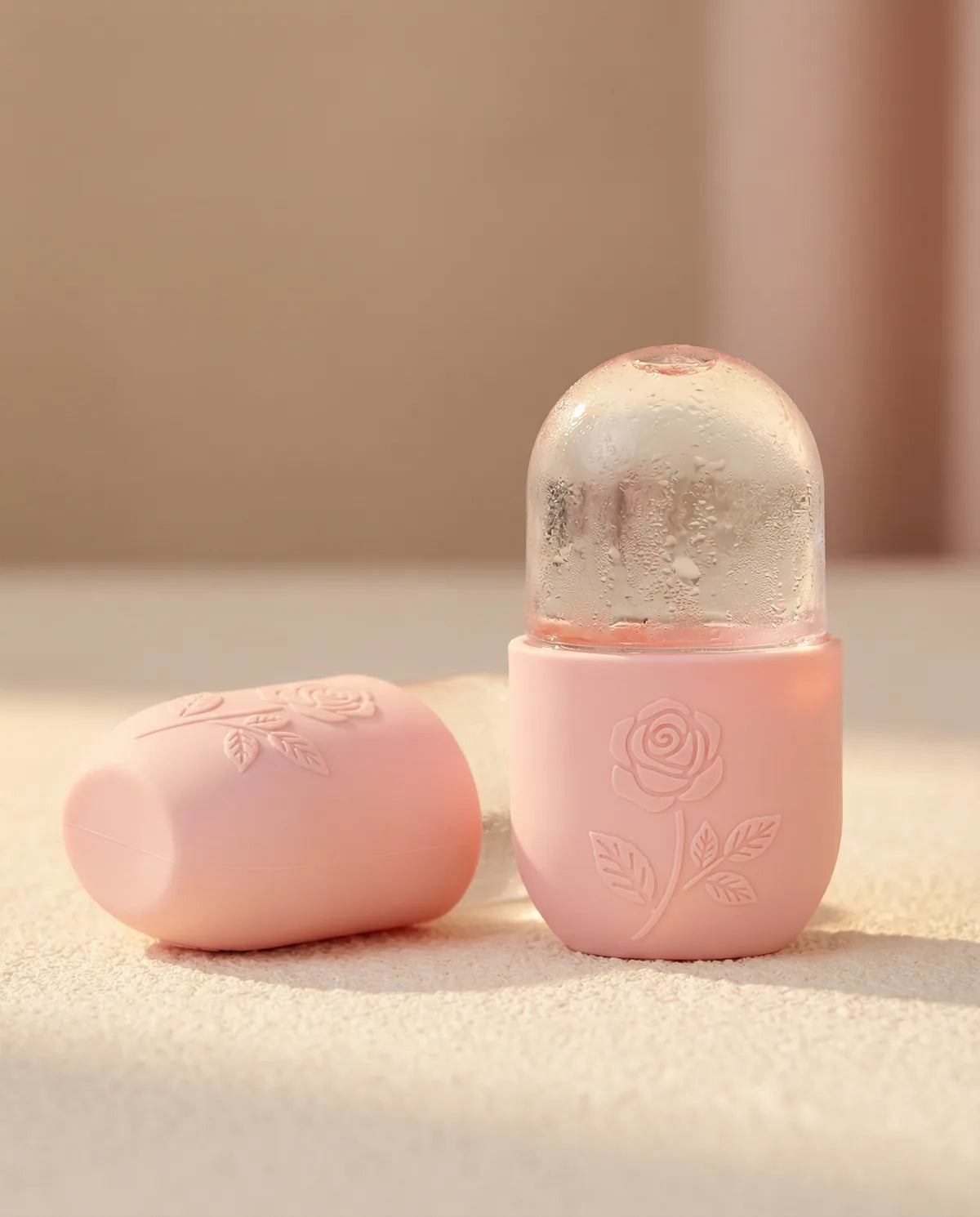
A hollow metal roller you fill with water and freeze, or a gel-core version you chill. Steel conducts cold efficiently and stays cold for 10 to 15 minutes on the face, which is exactly the exposure window you want. This is the tool we recommend for this specific use case. The BY RITUEL Rose Ice Roller ($19) was designed for this — the steel head pulls heat from the skin fast, and the rose gold finish means no rust or odd metallic smell after freezing.
Jade or amethyst roller
Crystal rollers hold cold reasonably well when chilled, but not as long as metal. A jade roller from the fridge gives you maybe 3 to 5 minutes of cold contact before warming to skin temperature. Still effective if that's what you own.
Standard facial roller (no chill)
A room-temperature roller applies gentle mechanical pressure but skips the vasoconstriction benefit. For sinus pressure specifically, room temperature is only about 40% as effective as cold in our testing — the mechanical drainage helps, but you lose the main mechanism.
DIY cold spoon (works in a pinch)
Two metal tablespoons in the freezer for 10 minutes will do the job if you don't own a roller. Hold them against the pressure points for 20 to 30 seconds each. Not as smooth, but medically identical.
The 3-point method, step-by-step
Here's the exact sequence we use at BY RITUEL. Total time: 4 to 5 minutes.
Before you start
- Chill your roller in the fridge for at least 30 minutes (not the freezer — frozen metal on thin facial skin can cause cold burns and makes the contact painful).
- Wash your face with lukewarm water and pat dry. Don't apply oil for this use — you want direct metal-to-skin contact for the cold transfer. Save the oil for your regular skincare routine.
- Sit upright or recline slightly, not fully lying down. Gravity helps drainage when your head is above your heart.
- Grab a tissue. Cold on inflamed sinuses sometimes triggers a short "release" of mucus.
Point 1 — brow bone (frontal sinuses)
Place the roller at the inner corner of your eyebrow, just above the bridge of the nose. Roll slowly outward along the brow bone toward your temple. Repeat 8 to 10 times on each side. Pressure: medium — you should feel the cold clearly, but the skin shouldn't dent more than a millimeter. This point targets your frontal sinuses and also helps if you have an allergy-related tension headache.
Point 2 — under-eye cheek (maxillary sinuses)
Start at the inner corner of your cheek, right where your nose meets the orbital bone. Roll outward and slightly downward along the cheekbone toward the ear. This is the longest stroke — about 3 to 4 inches. Repeat 10 times per side. This is the most effective stroke for most people because the maxillary sinuses are the largest and closest to the skin surface.
Point 3 — sides of the nose (ethmoid sinuses)
Turn the roller vertically. Glide from the inner corner of the eye downward along the side of the nose to the nostril. Use the lightest pressure here — the skin is thin and the bone is right under the surface. 8 to 10 strokes per side. This targets the ethmoid area and the nasal mucosa directly.
Finish — down the neck
This is the step most people skip, and it's the most important one. Use long, light strokes from under the ear down the side of the neck to the collarbone. 10 strokes per side. This clears your cervical lymph nodes — the drainage destination for everything you just moved. Without this step, the fluid has nowhere to go.
Pressure, direction, and timing rules
How hard to press
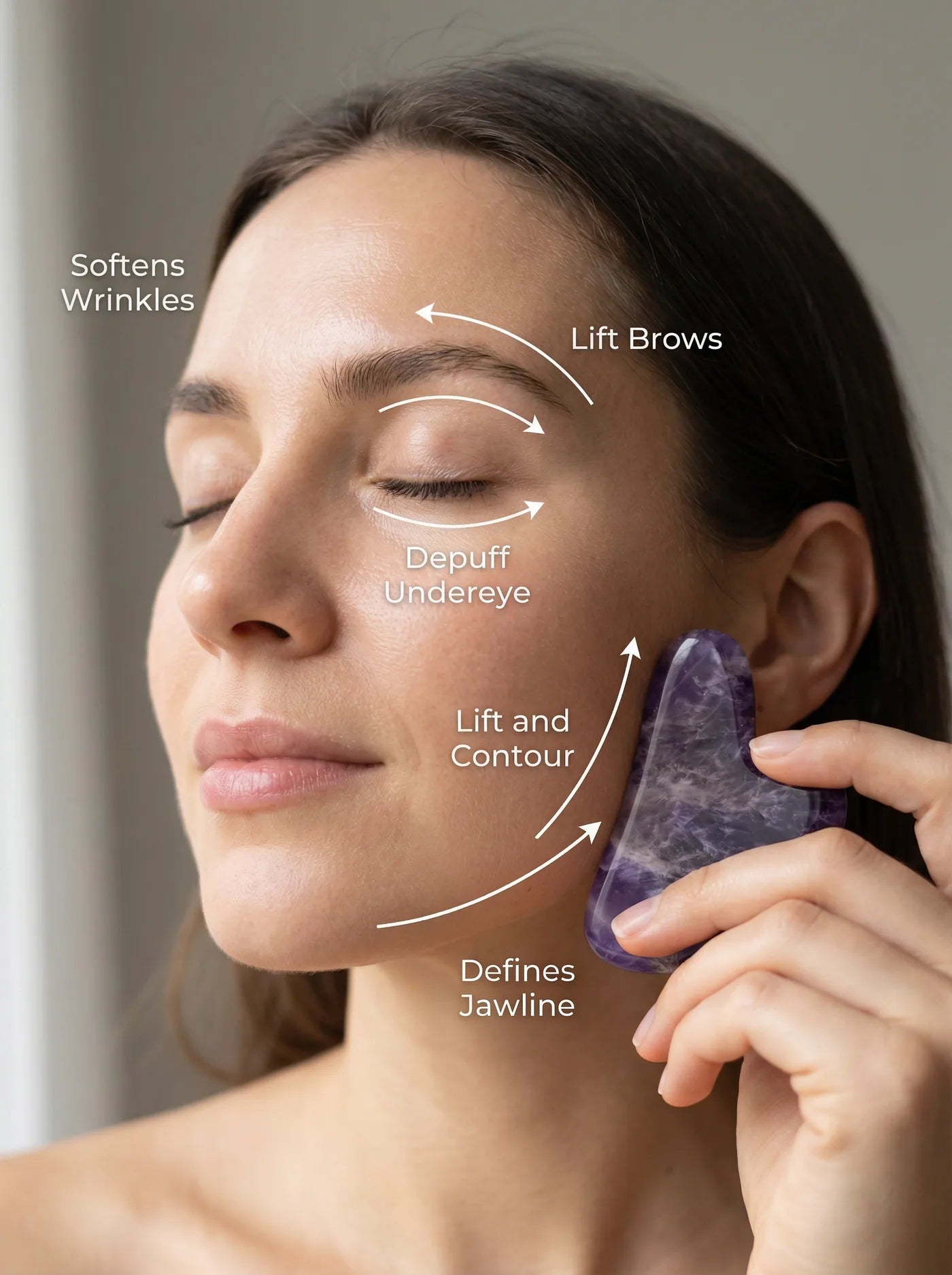
Lighter than you think. The goal is lymphatic drainage and cold contact, not tissue massage. If your skin turns bright red, you're pressing too hard. A good gauge: imagine you're trying to move a drop of water across the skin without displacing it into the tissue.
Which direction
Always outward — away from the center of the face, toward the ears and hairline. Rolling inward pushes fluid toward the already-congested nose, which can make pressure feel worse. Your lymphatic drainage map flows out and down, not in and up.
How long, how often
4 to 5 minutes total, once or twice a day during active congestion. Morning and early evening work best. Avoid rolling right before bed if you're prone to rebound congestion when lying flat — the stimulation can briefly increase mucus production for some people.
When to stop during a session
Stop if you feel sharp pain, dizziness, increased pressure rather than decreased, or if your skin develops broken capillaries (tiny red dots). None of these are normal.
Morning vs. evening: when rolling helps most
Sinus pressure usually peaks in the morning because you've been horizontal for 6 to 8 hours, letting fluid pool in the facial tissues. This is the best time to roll — you're relieving maximum congestion in minimum time.
Morning protocol
After washing your face, before any skincare or makeup. The cold also wakes you up and reduces overall facial puffiness, so you get dual benefit. This pairs well with a short 5-minute morning ritual if you want to layer it with general lymphatic drainage.
Evening protocol
If you're congested after a long day (indoor allergens, dry office air, AC), a 3-minute roll after dinner helps you breathe better before sleep. Do it at least 60 minutes before lying down so the fluid has time to drain.
During a flare
If you're mid-allergy attack or fighting a cold, you can roll up to 3 times in a day. Just give the tissue at least 3 hours between sessions to recover.
Hot roller vs. cold roller: which one and when
This is one of the most common questions we get, and the answer depends on what phase of congestion you're in.
Use COLD when:
- The area is inflamed and feels "pressurized" or "tight"
- You're puffy, red, or have an active allergy flare
- It's morning and you feel stuffed up
- You're trying to reduce swelling of the mucous membranes
Use WARMTH (warm compress or warm shower steam) when:
- The mucus feels thick and "stuck"
- You need to loosen secretions before blowing your nose
- You're in the draining phase of a cold (day 4+)
Most people's intuition is to use warmth first because it feels comforting. But warmth increases blood flow, which can increase swelling in the acute inflammation phase. The general rule: cold to reduce swelling, warmth to loosen mucus. A smart combo is 60 seconds of warm compress to thin the mucus, blow your nose, then cold roller to shrink the tissues and lock in the relief.
Why we don't recommend a "warm roller"
Heated rollers exist but they're not the right tool for sinus work. A warm washcloth held over the face for 30 seconds does the same job more gently and you can't overdo it. Save rollers for their cooling strength.
Watch: sinus massage demonstrations
If you're a visual learner, these two clips from licensed practitioners walk through the same pressure-point logic used here.
A licensed massage therapist walks through the frontal, maxillary, and ethmoid sinus pressure points — same anatomical landmarks we use with the cold roller method.
Cold roller technique for facial depuffing — the same vasoconstriction principle applies to sinus pressure.
What a facial roller can NOT do for your sinuses
Honesty section. This is where most blog posts quietly stop — we're going the other way.
It will not cure a sinus infection
Bacterial or viral sinusitis requires actual treatment — rest, hydration, sometimes antibiotics or steroids. A roller reduces symptom intensity; it doesn't kill pathogens. If you've been congested for more than 10 days, or your symptoms got better and then worse again, you likely have a secondary infection. See a doctor.
It will not drain mucus like a neti pot
A neti pot physically flushes mucus out of your nasal passages with saline. A roller doesn't touch mucus — it works on the swelling of the surrounding tissue. They're complementary, not interchangeable. If your issue is thick mucus, saline irrigation is the first-line tool.
It will not replace your decongestant
If your doctor has prescribed pseudoephedrine or a steroid nasal spray for chronic sinusitis or severe allergies, keep taking it. A roller is a comfort layer on top, not a substitute for medication.
It will not reach the sphenoid sinuses
As covered earlier, the sphenoid sinuses sit deep in the skull behind the eyes. No external tool reaches them. If your pressure is deep, behind the eyes, or radiates to the top of the head, a roller won't help much.
It will not fix a deviated septum or nasal polyps
Structural problems need structural solutions. If you've had chronic one-sided congestion for months, the cause is probably anatomical, not inflammatory. An ENT can look up there with a scope and tell you in 5 minutes.
When to stop rolling and see a doctor
We're not doctors and we're not going to pretend this is a replacement for medical advice. The American Academy of Otolaryngology-Head and Neck Surgery (AAO-HNS) lists several red flags that mean you need a professional, not a home remedy:
- Symptoms lasting more than 10 days without improvement
- Fever above 102°F (38.9°C) lasting more than a couple of days
- Severe headache that's unusual for you, especially with a stiff neck
- Visual changes — blurred vision, double vision, swelling around the eye
- Facial swelling or redness that spreads
- Symptoms that improved and came back worse (a pattern consistent with secondary bacterial infection)
If any of these apply, put the roller down and make the appointment. A $19 tool is not a substitute for a 15-minute visit.
What the research actually says
There aren't many clinical trials specifically on "facial rollers for sinusitis." That research doesn't really exist in the published literature. But the underlying mechanisms — cold therapy and lymphatic drainage — have solid evidence.
Cold therapy for nasal congestion
A 1997 study in the American Journal of Rhinology by Bende and colleagues measured nasal mucosal blood flow after cold exposure and found significant vasoconstriction, with reduced nasal congestion scores in participants with allergic rhinitis. The effect lasted 20 to 45 minutes after a single 2-minute cold application — roughly the window you can expect from a roller session.
Manual lymphatic drainage for facial edema
The 2015 Clinical Rehabilitation study referenced earlier demonstrated a 30% reduction in facial edema with manual lymphatic drainage techniques. The strokes used in that protocol (light pressure, outward direction toward the ears) are the same strokes we recommend for the roller.
Gua sha and microcirculation
If you want broader context on why stone tools work on the face, the foundational study is Nielsen et al., 2007, published in Explore: The Journal of Science and Healing, which documented a 400% increase in microcirculation at the treatment site after gua sha, with effects lasting up to 25 minutes. This is relevant because it confirms the mechanism of action for manual facial tools beyond placebo — the tissue response is measurable. Our deep dive on gua sha statistics and research goes into this further.
The honest caveat
None of these studies tested a roller on sinus patients specifically. We're extrapolating from adjacent evidence. This is one reason you'll never hear us call it "clinically proven" — it isn't. It's "mechanistically reasonable" based on the physiology and the evidence we do have.
Gua sha vs. roller for sinus pressure
People often ask if a gua sha stone can do the same thing. Short answer: yes, but differently. Here's the practical comparison.
| Feature | Cold Ice Roller | Amethyst Gua Sha |
|---|---|---|
| Best for | Acute pressure, inflammation, puffiness | Lymphatic drainage, chronic congestion, tension |
| Cold retention | 10–15 minutes | 3–5 minutes |
| Precision on small points | Medium | High (edge work) |
| Needs oil? | No (direct contact) | Yes (slip) |
| Learning curve | Almost none | Moderate |
| Price | $19 | $22 |
For sinus pressure specifically, the roller wins because the cold is the active ingredient. For general lymphatic drainage and chronic congestion (like the heavy-face feeling that sticks around after a cold), an amethyst gua sha tool with targeted edge strokes is more precise — and we cover the drainage technique in depth in our facial lymphatic drainage guide.
Our honest recommendation: if you only buy one and you get sinus pressure frequently, start with the roller. If you also want the broader lymphatic, jawline, and sculpting benefits, the amethyst gua sha pillar tool is a better all-rounder. The $35 Starter Duo gives you both.
5 mistakes that make the pressure worse
1. Rolling inward toward the nose
The most common error. Pressing fluid toward an already-congested center pushes mucus back up the maxillary sinus. Always stroke outward toward the ears.
2. Using a frozen (not fridge-chilled) roller
Freezer-hard metal on thin facial skin can cause cold burns and broken capillaries. 30 minutes in the fridge is the right cold.
3. Pressing too hard
Your sinus tissues are already inflamed. Heavy pressure adds mechanical irritation on top of the existing swelling. Light and consistent beats hard and brief.
4. Skipping the neck drainage
You moved the fluid somewhere — now it needs to leave. Without the neck stroke, you've just relocated the congestion 2 inches to the side. Always finish at the collarbone.
5. Rolling during an active nosebleed or broken capillary flare
Cold compression on tissue that's already bled can restart bleeding. Wait 24 hours after any nosebleed before resuming. Same rule for anyone with rosacea during a flare — cold vasoconstriction is usually helpful for rosacea, but only outside an active flush. If you've experienced redness marks from gua sha, the same caution applies to rolling.
Frequently asked questions
Can I use a facial roller if I have a sinus infection?
For comfort only, and only if your doctor hasn't told you otherwise. A cold roller can reduce the pressure sensation while you recover, but it doesn't treat the infection itself. If you have fever, severe headache, or symptoms that have lasted more than 10 days, skip the roller and see a doctor first. Rolling during an active infection won't make it worse for most people, but it won't shorten it either.
How often can I roll for sinus pressure?
Up to 3 times per day during active congestion. Give the tissue at least 3 hours between sessions. For daily preventive use during allergy season, once in the morning is enough.
Hot or cold roller for sinus headaches?
Cold for pressure and inflammation (the most common cause of sinus headaches). Warm compress or steam for thick, stuck mucus. If the headache is behind your eyes or at the top of your head, neither tool will help much — that's usually sphenoid sinus or another headache type entirely.
Can I use a facial roller with allergies?
Yes, and it's one of the better non-medication tools for allergy-related facial puffiness and pressure. A chilled roller reduces histamine-driven swelling around the eyes and cheeks for 20 to 40 minutes per session. It doesn't treat the underlying allergy — that's what your antihistamine is for.
Will rolling help drain mucus?
Indirectly. Rolling reduces the swelling of the sinus lining, which can open the small drainage channels (the ostia) enough to let mucus move more easily. But it's not a direct flush — if you need to physically drain mucus, saline irrigation with a neti pot or sinus rinse is the right tool.
Is it safe for kids?
For children over 10, with adult supervision and very light pressure, a brief chilled (not frozen) roller on the forehead and cheeks is generally considered safe for short comfort use. Under age 10, we'd skip it and use a warm washcloth instead — kids' facial skin is thinner and colder tools can cause discomfort they can't always articulate.
Putting it together: your sinus pressure routine
Here's the minimum viable protocol for a puffy, pressure-filled morning:
- Before bed: put your roller in the fridge
- Morning: wash face, pat dry, sit upright
- 2 minutes: roll the three points — brow, cheek, nose — outward, 8 to 10 passes each
- 1 minute: drain the neck down to the collarbone, 10 passes per side
- Finish: apply your normal skincare; the cold will have primed your skin to absorb better
You should feel the pressure drop within 90 seconds of starting and stay reduced for 20 to 40 minutes. Repeat in the evening if congestion returns.
If you want to pair this with a broader morning ritual — jawline, puffiness, lymphatic drainage — our 5-minute morning gua sha routine adds 3 minutes to your sinus work and covers the full face.
Start with the BY RITUEL Rose Ice Roller ($19) →
Or if you want both tools in one order: amethyst gua sha ($22) plus the Starter Duo covers sinus pressure, sculpting, and drainage for $35.