
Published April 19, 2026 · Reading time: 10 minutes
Metal Gua Sha vs Stone: Which One Should You Actually Buy?
You've been scrolling, and half the videos show a woman gliding a sleek stainless steel tool across her cheekbone — the metal literally glinting in ring light — while the other half show a warm purple amethyst stone resting on someone's collarbone next to a ceramic mug of matcha. Same category. Completely different vibes. And you're trying to figure out which one is actually worth the $20-40.
We've sold thousands of amethyst gua sha stones. We've also tested metal tools at length. So when people ask us metal gua sha vs stone, we don't give the marketing answer — we give the real one. This guide breaks down both sides honestly, tells you which wins on each factor, and helps you choose based on what you actually want out of the tool.
Key takeaway:
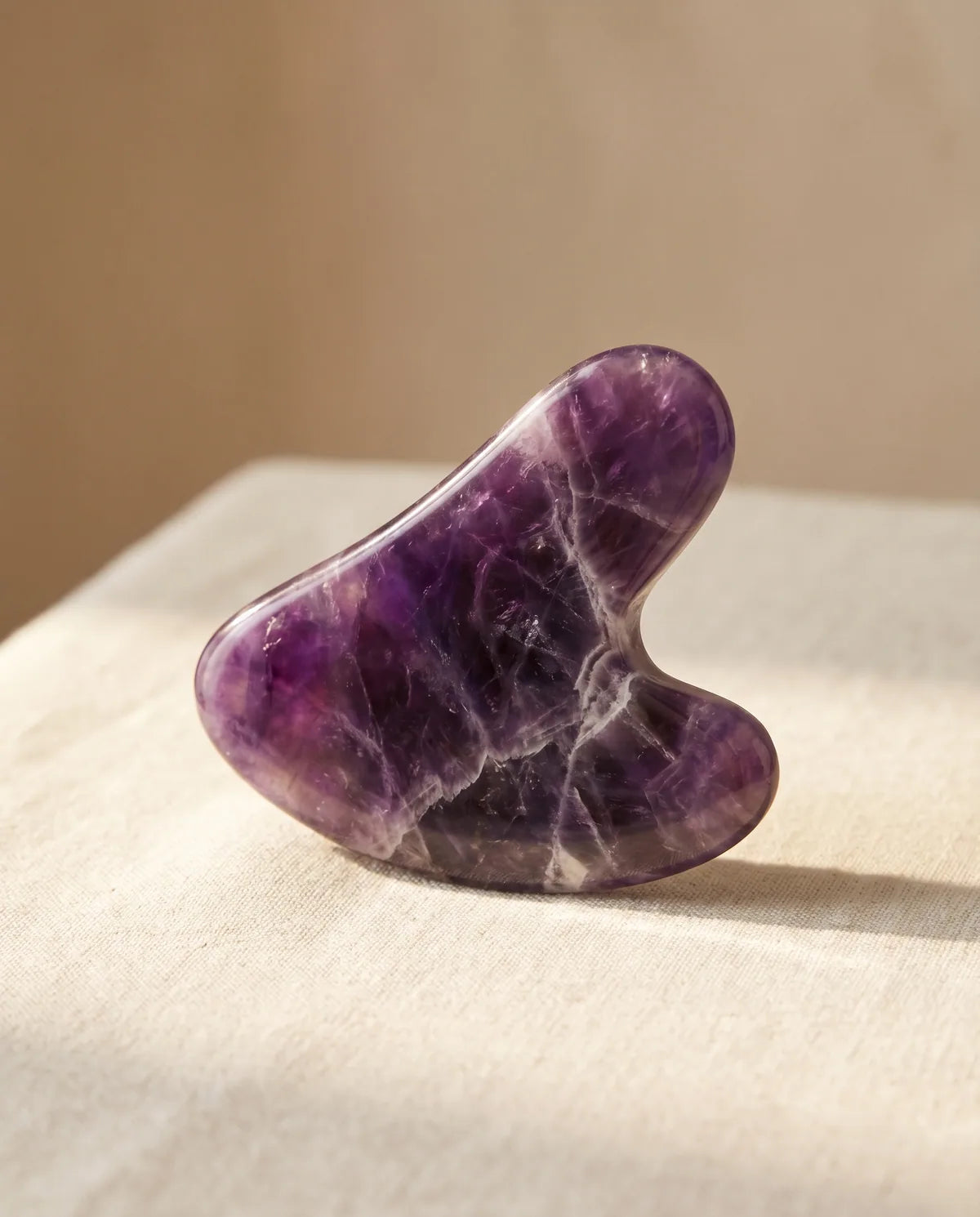
Metal gua sha (typically stainless steel) cools faster and retains cold longer — better if your main goal is morning depuffing via cold therapy. Stone gua sha (amethyst, jade, rose quartz) stays at ambient temperature for gentler, longer massage sessions and carries the traditional TCM lineage. Most people are better served by stone for daily ritual, with a dedicated cold tool (ice roller) layered in for puffiness.
Quick answer: which one wins?
Here's the TL;DR table we wish someone had shown us before we tested both:
| Factor | Metal wins | Stone wins |
|---|---|---|
| Cold therapy / depuffing | Yes | — |
| Gentle daily massage | — | Yes |
| Hygiene / non-porous | Yes | — |
| Durability (won't shatter) | Yes | — |
| Grip with facial oil | — | Yes |
| TCM / traditional lineage | — | Yes |
| Ritual / aesthetic feel | — | Yes |
| Sensitive / reactive skin | — | Yes |
Score: stone wins 5, metal wins 3. But "winning" depends entirely on what you're trying to solve. Keep reading — the nuance matters.
The one-line buying rule
If you wake up puffy and want fast morning depuffing, metal is appealing — but honestly a dedicated cold tool like an ice roller beats both. For daily massage, sculpting, tension release, and a calming ritual, stone is the better fit.
Thermal properties — the biggest difference
This is the number-one reason people choose between the two, and most articles handle it badly. Let's be precise.
Why metal feels colder
Stainless steel has a thermal conductivity of roughly 15 W/m·K. Copper is dramatically higher (around 400 W/m·K). Natural stones like amethyst, jade, and rose quartz sit far lower — generally in the 2-5 W/m·K range depending on composition. Translation: metal pulls heat away from your skin faster. That's why a room-temperature metal tool feels cold to the touch while a room-temperature stone feels neutral.
What that means in practice
Metal, fresh out of the fridge, stays cold on the skin for 3-5 minutes before it equilibrates to body temperature. A stone cools down too — but it also warms up faster on contact, which is actually what most people want for a relaxing massage session. If your goal is cold therapy, metal wins. If your goal is a gliding 10-minute sculpt, the metal is ironically counterproductive because you want a tool that stays neutral, not icy.
The cold-therapy shortcut
Both metal and stone tools are often thrown in the fridge for cold therapy. Honestly, we've tested this — the cold only lasts a couple minutes either way. If you actually want sustained cold to shrink morning puffiness, a dedicated ice roller or ice globe is built for that job. It's designed around the cold. A gua sha isn't.
Hygiene and porosity
This is where metal has a real, undeniable advantage — and we're going to be honest about it.
Metal is non-porous
Stainless steel (and solid copper, and zinc alloys) is completely non-porous. You can wipe it down with soap and water, alcohol, or a disinfectant and the surface is genuinely clean. Nothing seeps in. Nothing hides in microscopic pores. For anyone prone to breakouts, hyperpigmentation triggered by bacterial contamination, or just generally paranoid about skincare tool hygiene, metal is easier to keep medically-clean.
Stone is lightly porous
Natural crystals like amethyst, jade, and rose quartz have micro-porosity — a polished surface looks smooth, but at the molecular level there's more texture than stainless steel. In practice, this means:
- You should wash your stone after every use with warm water and mild soap.
- Dry it immediately — moisture trapped on the surface is the real hygiene risk.
- Avoid using alcohol or harsh disinfectants that can dull or etch the stone over time.
It's not dirty if you take care of it. But it demands slightly more attention than a steel tool that you can essentially sterilize.
Our honest take
If you've been lax about cleaning skincare tools and think you'd keep being lax, get metal. If you're the kind of person who rinses their makeup brushes weekly and cares about routines, stone is fine — and the ritual of rinsing and drying the stone is part of the daily practice anyway. For skin that's reactive or prone to breakouts, the cleaning discipline matters more than the material choice.
Weight, grip, and how it feels in hand
This is where subjective preference kicks in hard.
Metal is heavier
A stainless steel gua sha typically weighs 90-140 grams. A zinc or copper alloy tool can hit 150+ grams. The heft feels substantial — some people love it because the tool does the work of pressure for you. You just glide, and gravity plus density provide the right resistance.
Stone is lighter and more ergonomic
A natural amethyst gua sha usually weighs 50-90 grams — noticeably lighter. For people who do long sessions (10+ minutes), the lighter weight reduces hand fatigue. For people who want to work small areas like the under-eye, a lighter tool gives more control.
Grip with oil
Here's a detail almost nobody mentions: metal gets slippery fast when you add facial oil. Stone, because of its very slight texture, actually grips the oil better and stays controllable. After about 2-3 drops of oil, a metal tool can slide out of your fingers mid-stroke. This matters more than you'd think.
Temperature comfort
Because metal pulls heat aggressively, a room-temperature metal tool can feel uncomfortably cold on thin skin areas (under-eye, temples, neck) — especially in winter. Stone equilibrates to skin temperature within a minute, which is objectively more comfortable for most daily use.
Durability — will it break?
Let's address the elephant in the bathroom: yes, stone gua sha can crack if you drop it on a tile floor.
Metal is basically indestructible
Stainless steel won't chip, crack, or shatter. You can drop it from counter height onto tile and it'll dent the tile before it dents itself. If you travel a lot, have kids, or just know yourself, metal wins on pure survival odds.
Stone can crack — here's the reality
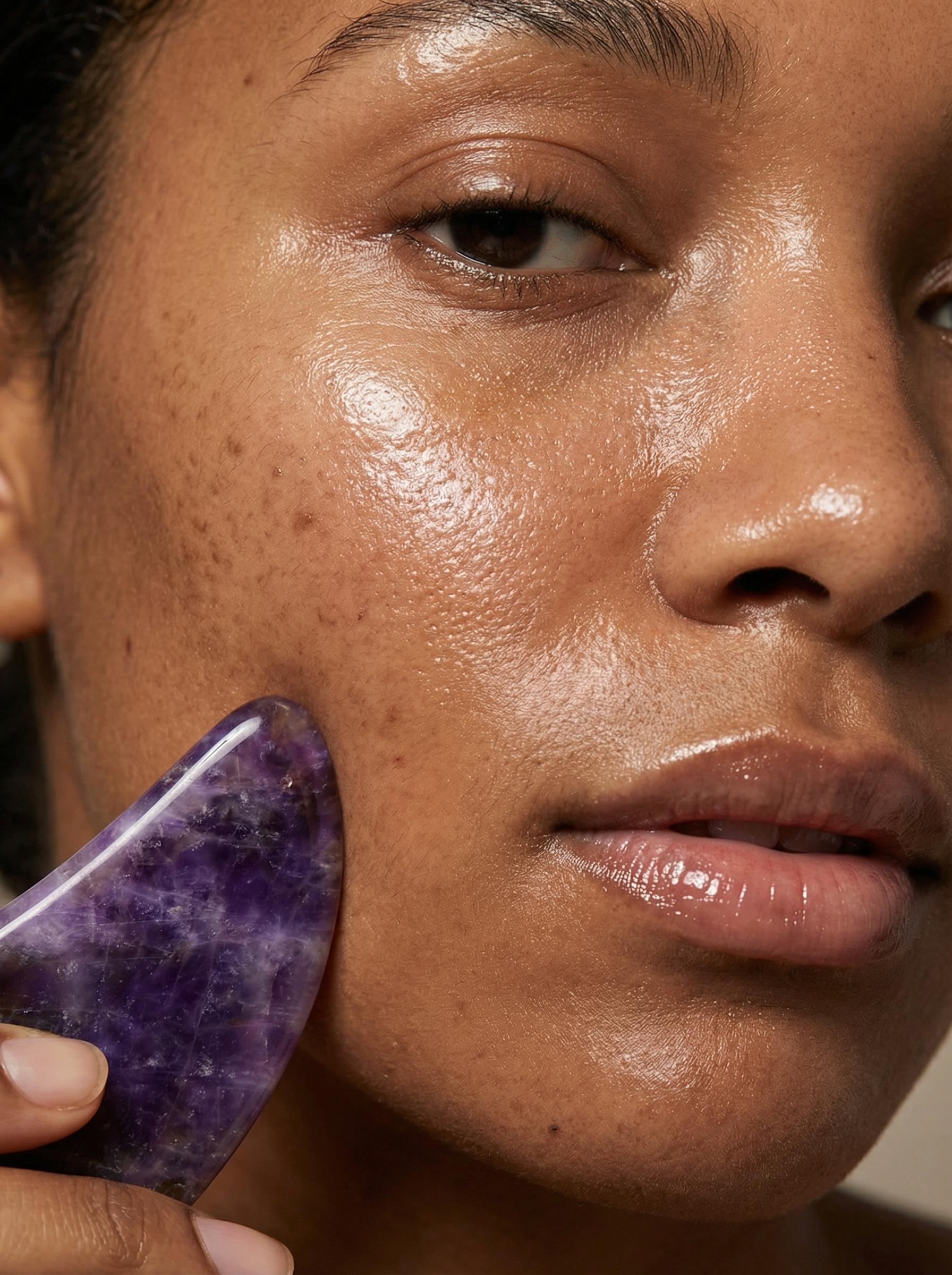
Amethyst is a quartz variety with a Mohs hardness of 7. It's relatively tough, but it's still crystalline — drop it on tile or porcelain and it can chip or split along a fault line. In our own testing (and customer reports), the most common break scenario is:
- Dropping it on the edge of the sink or the bathroom floor.
- Knocking it against a ceramic soap dish.
- Taking it in checked luggage without padding.
How to prevent breakage
- Keep it in the pouch it shipped in when not in use.
- Do gua sha while sitting, not standing — if it slips, it falls into your lap, not onto tile.
- Store in a drawer, not on the edge of a shelf.
- If you travel, wrap it in a sock or use the original pouch.
We include a pouch with every order for exactly this reason. And our 2-year warranty covers natural defects (not drops — no tool can warranty user error).
Tradition and TCM lineage
This is the part the metal-tool brands don't talk about. Because they can't.
Gua sha is a TCM practice, not a tool
The technique of "gua sha" — literally "scraping sand" in Mandarin — has been used in Traditional Chinese Medicine for centuries, originally on the body (not the face) to release stagnation. The tools were traditionally made of horn, bone, jade, or other natural materials. Metal tools are a modern Western adaptation that emerged in the 2010s, primarily driven by aesthetic and hygiene marketing.
Why stone carries the lineage
Jade has been the traditional facial gua sha material for generations. Amethyst, rose quartz, and bian stone entered the practice as jade became more expensive and as practitioners experimented with different stones for their properties. All of these have some claim to the tradition. Metal has essentially none — it's a contemporary invention framed as gua sha because the shape is similar.
Does that matter?
Depends on why you're doing this. If you want efficient skin manipulation and don't care about cultural roots, metal is fine — it's a tool, use what works. If part of the appeal is connecting with a centuries-old practice, intentionally slowing down, and treating skincare as ritual rather than task, stone is the more honest choice.
We make amethyst gua sha because we believe that slowing-down ritual is the actual benefit. The physical stroke improves lymphatic flow, yes — but the daily 5-minute pause is what keeps people consistent, and consistency is what delivers results.
Aesthetic and ritual feel
We know this sounds superficial. It isn't. Daily habits live or die by how the objects make you feel.
Metal = clinical, modern, efficient
A stainless steel gua sha on your vanity reads tool. It looks like something a facialist uses in a treatment room. That's appealing if your aesthetic is minimalist-tech — think clean bathroom counters, matte fixtures, Everlane rugs.
Stone = natural, warm, ritual
An amethyst stone next to your favorite moisturizer and a sprig of dried lavender reads practice. It looks like something you pick up slowly. It pairs with candles and Japanese skincare and slow mornings. It signals "this is a moment for me," not "here's a task to complete."
Which matters more than you'd think
There's no science we can point to, but there's strong practical observation: people who buy stone gua sha tend to use them more consistently than people who buy metal. Our hypothesis is that the ritual feel drives daily habit, and metal tools end up in drawers because they don't invite the pause. Your mileage may vary.
Price and long-term value
Both categories span a wide price range. Here's the honest landscape:
Metal pricing
- $15-25: Budget stainless steel, mass-produced, often lightweight.
- $30-60: Mid-range — better finishing, heavier weight, branded options.
- $70+: Premium brands with heat/cool tech (chargeable), warranty, medical-grade claims.
Stone pricing
- $10-18: Budget jade or dyed stones. Often not genuine material.
- $18-30: Mid-range — our Amethyst Gua Sha ($22) sits here. Genuine natural stone, quality polish.
- $40-80+: Premium "spa grade" stones, larger sizes, fancy branding.
Long-term value
Metal lasts essentially forever if you don't lose it. Stone can last decades with reasonable care. Both are one-time purchases — no subscription, no replacement blades, no recurring cost. The real question is cost-per-use, and both can deliver sub-cent-per-use value if you actually stick with the routine.
What the research actually says
Here's where most blog posts invent studies. We'll tell you what's real.
What's proven about gua sha (regardless of material)
A 2007 study by Nielsen et al., published in Explore: The Journal of Science and Healing, measured microcirculation before and after gua sha strokes. They found a 400% increase in surface microperfusion lasting up to 25 minutes post-treatment. Critically, this study used a traditional ceramic-Chinese-soup-spoon tool — not metal, not jade, not amethyst. The effect came from the stroke mechanics, not the tool material.
A follow-up study by Kuo et al., 2004, in the Journal of Alternative and Complementary Medicine, showed gua sha upregulates heme oxygenase-1 (HO-1), an anti-inflammatory enzyme. Again — the mechanism is the tissue manipulation, not what the tool is made from.
What about lymphatic drainage?
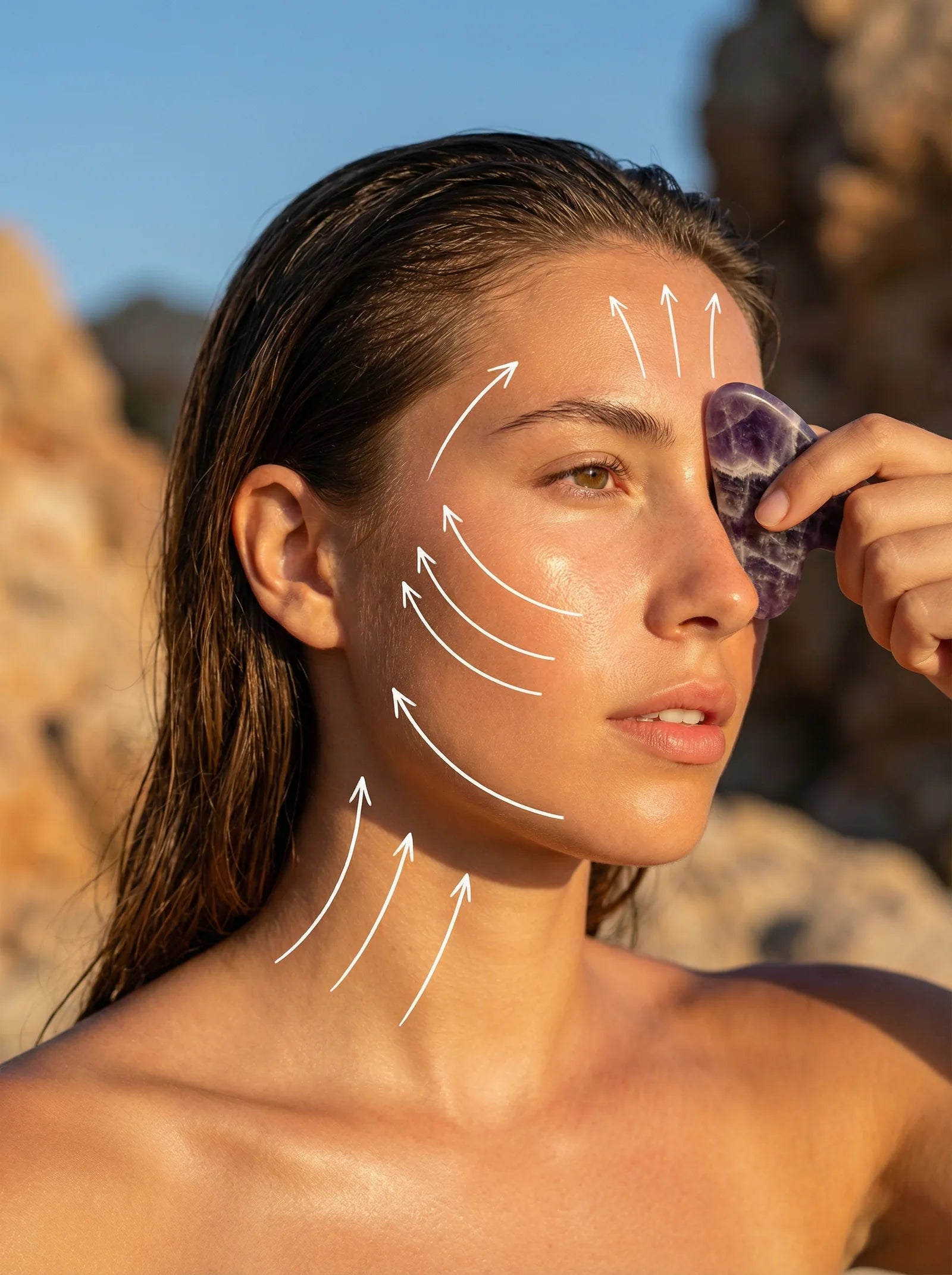
A 2015 paper in Clinical Rehabilitation showed manual lymphatic drainage reduces facial edema by roughly 30% after repeated sessions. Gua sha strokes, when performed along lymphatic pathways (cheek-to-ear, jawline-to-neck, neck-to-clavicle), recruit the same mechanism. Material doesn't change this. Technique does.
The honest conclusion
There is zero published evidence that metal produces better results than stone, or vice versa. Anyone claiming their material is "clinically proven" for facial results is overselling. The research supports the technique. Choose the tool you'll actually use consistently — that's the variable that matters.
What neither one can do
We owe you the honesty section. Here's what no gua sha — metal, stone, or anything else — can accomplish:
- Burn facial fat. Gua sha doesn't slim your face by reducing adipose tissue. What it reduces is fluid retention (edema), which can look like a slimmer face.
- Erase genetic features. If your bone structure or fat pad distribution gives you certain facial shapes, gua sha won't rebuild your skeleton.
- Replace a deep-clean routine. It's not a cleanser, not a chemical exfoliant, not a retinoid. It complements — doesn't replace — your core skincare.
- Deliver results in one session. You'll see some depuffing immediately. But visible sculpting results take 4-8 weeks of near-daily practice.
- Fix deep wrinkles. Static wrinkles that remain when your face is at rest need collagen-stimulating treatments (retinoids, peptides, professional procedures). Gua sha softens dynamic tension lines — not deep structural ones.
If someone is selling a tool with claims outside this list, the claims are marketing, not reality.
The stack we actually recommend
Here's what we tell customers who can't decide:
Option 1: Daily ritualist (most people)
One Amethyst Gua Sha ($22) and a bottle of Rosehip Oil ($15). Total: $37. Use the stone daily for 5 minutes, oil as slip. This is the core ritual and it delivers 80% of what anyone gets from this category.
Option 2: Puffiness-focused stack
Add an ice roller to the stack above. Use the ice roller for cold therapy in the morning (depuffing, closing pores, reducing redness) and the stone for sculpting and tension release. This covers both the cold-therapy benefit that metal gua sha advocates often cite and the sustained-massage benefit that stone excels at. Best of both worlds without the metal gua sha compromise.
Option 3: Minimalist
Just one stone. Five minutes every morning. No oil even (dry gua sha is controversial but many people do it). This is where we started. Ritual first, tool collection later.
What we don't recommend
Replacing your stone with a metal tool to "upgrade." You won't. They do different jobs. If you want the cold-therapy benefits of metal, buy an ice roller that's actually designed for it — you'll get dramatically more cold duration for similar or less money.
What estheticians and creators say
Don't just take our word for it. Here are two video perspectives from outside our brand that walk through metal vs stone thoughtfully:
FAQ
Is metal gua sha better than stone?
Not better or worse — different. Metal cools faster and is easier to sanitize, which is useful for cold therapy and breakout-prone skin. Stone stays at skin temperature for comfortable long sessions, grips facial oil better, and carries the traditional TCM lineage. Most daily users are better served by stone. If cold therapy is your priority, an ice roller beats both.
Can metal gua sha cause rust or skin reactions?
Quality stainless steel (304 or 316 grade) doesn't rust under normal use. Cheaper metal tools, particularly coated ones, can develop surface oxidation over time. Some people with nickel sensitivity can react to certain steel alloys — if you have known nickel sensitivity, stick with stone or verify the alloy grade before buying.
Does amethyst gua sha really work, or is it just a trendy stone?
The stone material itself doesn't have magical properties — the benefits come from the technique, as shown by Nielsen et al. 2007 and Kuo et al. 2004. Amethyst is an excellent vehicle for the technique because of its hardness, polish, and stable surface. The pillar guide walks through why we specifically chose amethyst over jade or rose quartz.
Which material is best for sensitive skin?
Stone, generally. It equilibrates to skin temperature faster (avoiding the cold-shock some sensitive skin experiences with metal) and the slightly textured surface produces less friction drag with oil. See our sensitive skin guide for full protocol.
How do I clean each type?
Metal: soap and water, or wipe with 70% isopropyl alcohol. Dry with a clean cloth. Stone: warm water and mild soap, rinse thoroughly, dry immediately with a soft cloth. Avoid alcohol on stone — it can dull the polish over years. For both, clean after every use, not weekly.
Can I use a metal and a stone tool together?
Yes. Many people use a metal tool chilled in the fridge for a 2-minute morning cold pass, then switch to stone for the main 5-10 minute sculpting session. Honestly though, an ice roller does the cold-pass job better than a chilled metal gua sha — we'd prioritize that stack.
The bottom line
Metal gua sha and stone gua sha are not the same tool with different aesthetics. They're closer to cousins — similar shape, overlapping use cases, genuinely different feel and purpose. Metal wins on cold retention, hygiene, and durability. Stone wins on grip, comfort, tradition, and ritual consistency.
We chose stone — specifically amethyst — because the research is technique-driven (material doesn't change clinical outcomes), and the ritual feel drives the daily habit that actually delivers results. If cold therapy is a major priority, layer in a dedicated ice roller. You'll get more cold and a tool designed for the job.
Start with the BY RITUEL Amethyst Gua Sha ($22) →
And if you want the stroke sequence we use every morning — same one regardless of tool material — grab the free printable below.